Circuits with Two Level Systems for Defect Characterization:
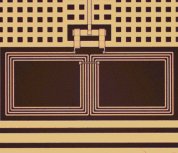
Superconducting resonators and qubits, which are enabled by superconductors as quantum materials, are studied to better understand their potential performance in future quantum computers. Most studies focus on resonator coherence, using different types of amorphous nitride and oxide dielectrics as well as phase-textured nitride and aluminum superconductors. By definition qubits have two-levels, but this group especially develops methods to characterize material-based two-level systems (TLSs) as defects in circuits to understand qubit decoherence. In the circuit from the adjacent figure, TLSs were first brought into resonance with a microwave resonator in a demonstration of a new Cavity-QED system. In another circuit study, TLSs are manipulated coherently with energy sweeping to allow net population inversion of TLSs despite their random nature. This enables a new microwave laser from the stimulated emission from random-systems (TLSs). These studies elucidate coherence, the individual nature of TLSs, kinetic inductance, phase noise, etc.
Ballistic Fluxon Devices:
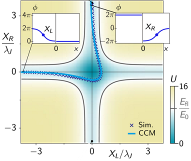
Industry-standard digital logic uses irreversible gates whose energy dissipation is reaching a known minimum. The physics of reversibility allows an energy efficient and thermodynamically inspired alternative. We study proposed structures will ballistic fluxons as information carriers, that are solely powered by the momentum of those bits. For this work, we use long Josephson junctions (LJJs), and the fluxon within them, which does not exhibit dispersion or significant loss during travel. Devices use pairs of undamped LJJs and circuits between them. In the digital logic gates, the system allows a novel change in fluxon polarity (topological charge) using energy only from incoming fluxons (without adiabatic waveforms). Structures related to the unusual basis of the bit states (which have two different fluxon polarities) have been tested experimentally. In a separate incubator project, a fast qubit readout has been developed with fluxons.
Defect Spectroscopy in Qubits:
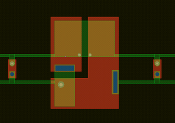
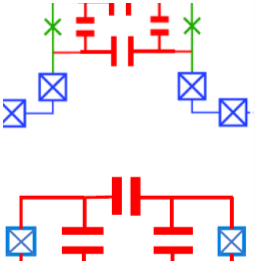
A Josephson junction is sometimes called the nonlinear circuit element enabling superconducting qubits. The nonlinearity allows usage of two states for quantum-state manipulation. We are starting a new project to characterize individual quantum defects in qubits with electric field tuning. This will allow us to gain quantitative information that is currently not available in other targeted studies. The key advancement from our group is electric-field tuning of defects, but this may be combined with magnetic field tuning of the qubit.
|