Development of
Superconducting Gravity Gradiometers
Precise gravity measurements are required to study the fundamental nature of gravitation. Measurements of gravity can also provide a better understanding of the Earth and the planets, help find natural resources, and improve inertial navigation and surveying. To distinguish gravity from platform accelerations, the Equivalence Principle requires a differential measurement. A gravity gradiometer detects a spatial derivative of the gravitational field and ideally is immune to the vibrations of the platform.
Several versions of the superconducting gravity gradiometer (SGG) have been developed. A three-axis in-line component SGG with a baseline of 19 cm, developed with NASA support, reached a performance level of 2 ´ 10-11 s-2 Hz-1/2 in the laboratory, which is three orders of magnitude more sensitive than the demonstrated sensitivities of atom gravity gradiometers to date. A short movie is available showing the gravity gradient signal from a 1.45-kg lead block and a 0.35-kg aluminum block. The blocks are mounted on a 50-cm diameter turntable located next to the cryostat, which houses the three-axis SGG.
The achieved common-mode rejection of 107 is sufficient for a spacecraft environment. However, for terrestrial moving-base applications, the linear acceleration rejection must be improved to 109 or higher. A cross-component device can be designed to be inherently insensitive to linear accelerations by employing pivoted moment arms whose mass moments are precisely balanced prior to assembly. We have developed such a cross-component SGG and demonstrated sensitivity better than 10-9 s-2 over a bandwidth of 0.001 to 2 Hz.
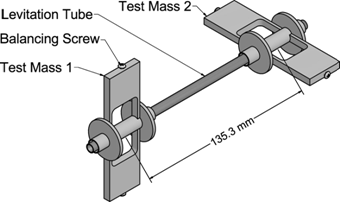 The existing SGGs have mechanically suspended test
masses. Magnetic levitation gives a number of advantages. The resulting
magnetic spring is much more compliant and gives two degrees of freedom to each
test mass. Hence a tensor gradiometer can be constructed with only six
test masses, and sensitivity better than 10-12
s-2 Hz-1/2 can be achieved with a device
miniaturized by an order of magnitude in volume and mass over the existing
devices. Such a tensor SGG is under development with NASA support
for Earth and planetary applications.
The existing SGGs have mechanically suspended test
masses. Magnetic levitation gives a number of advantages. The resulting
magnetic spring is much more compliant and gives two degrees of freedom to each
test mass. Hence a tensor gradiometer can be constructed with only six
test masses, and sensitivity better than 10-12
s-2 Hz-1/2 can be achieved with a device
miniaturized by an order of magnitude in volume and mass over the existing
devices. Such a tensor SGG is under development with NASA support
for Earth and planetary applications.