Teaching Physics with the Physics Suite
Edward F. Redish
Home | Action Research Kit| Sample Problems | Resources | Product Information
Problems Sorted by Type | Problems Sorted by Subject | Problems Sorted by Chapter in UP
|
Teaching Physics with the Physics Suite Edward F. Redish Home | Action Research Kit| Sample Problems | Resources | Product Information |
Problems Sorted by Type | Problems Sorted by Subject | Problems Sorted by Chapter in UP |
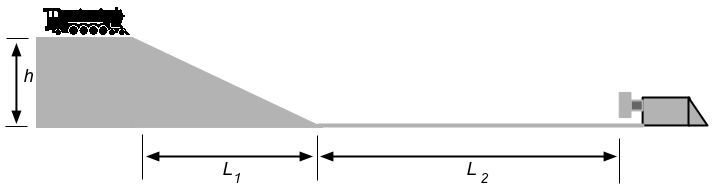
A toy train of mass m comes off a hill traveling at a velocity v0, rolls down an incline of height h, rolls a short distance on a straight track, and strikes a bumper containing a spring of spring constant k. The distances are as indicated on the figure below. The train is just rolling, not powered.
Page last modified November 13, 2004: PE25