 QUANTUM MECHANICS I
Spring 2008
Course description:
PHYS401
Quantum Physics I;
(4 credits)
Grade Method: REG/P-F/AUD.
Prerequisite: PHYS273. Corequisites: PHYS374 and MATH240. Credit will be
granted for only one of the following: PHYS401 or PHYS421. Formerly
PHYS421.
Introduces some quantum phenomena leading to wave-particle duality.
Schroedinger theory for bound states and scattering in one dimension.
One-particle Schroedinger equation and the hydrogen atom.
0101(57736)
Brill, D. (Seats=40, Open=6, Waitlist=0) Books
- M......... 3:00pm- 4:50pm (PHY 1402)
- W......... 3:00pm- 4:50pm (PHY 1402)
Instructor:
Dieter Brill
4202 Physics Building
(301) 405 6027
Office Hour: TBA
Grader:
none
 Textbook:
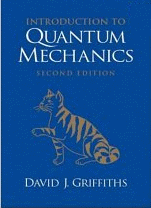
Introduction to Quantum Mechanics by David J. Griffiths. This book has been used for this course for a number of years. The current edition is the second edition. (A used first edition will be acceptable, recognized by the cat facing to the right.)
If you don't have your book yet you can read the first 7 pages at Amazon.We will follow the topics of this book fairly closely.
Exams, Homework
We will have at least one mid-term exam and a final exam, both lasting two hours, and counting approximately equally toward your final grade.
The Solution to the Midterm Exam is found here
You will also have weekly homework, counting about 20% of the final grade.
Homework will be due on Mondays, and will be discussed (by you) on the following Wednesday.
Homework problems, their solutions, and other items about the course will be posted on Blackboard (https://elms.umd.edu), whereas the present page will not be further updated. However, here is the
First Assignment
Problems due Monday, February 4 (to be discussed in class Wednesday, February 6)
- In this problem you will generalize the development of the text's section 1.4 to three dimensions. The only difference in the Schrödinger equation [1.1] is that the second partial derivative is replaced by the Laplacian [4.5], so the equation has the form [4.4].
It is simplest to think of the Laplacian as div⋅grad, and to use the divergence theorem in the step from [1.25] to [1.26].
- You want to prove òòò|Y|2dxdydz = 1, so work out its time derivative as in [1.21]-[1.27], explaining each step.
- Do problem 1.14 (a), and its generalization to three dimensions.
Hint: problem 4.41, p. 191.
- The Bohr atom is a classical system in which a point electron moves in a circular orbt of radius r around a fixed nucleus. Quantization is effected by excluding all orbits except those of angular momentum n
h, where n is an integer.
- Write down the magnitude of the (linear) momentum in the lowest Bohr orbit (n = 1).
- Quantum mechanically, the electron cannot be exactly on the Bohr orbit and stay there (zero radial momentum) because of the uncertainty principle. But can it be approximately on this orbit, so its position is, say, within 10% of the radius of the Bohr orbit, and its momentum is within 10% of the momentum you found in a.?
- Suppose, on the contrary, that the distance r of the electron from the nucleus is due entirely to its "fluctuation" imposed by the uncertainty principle, and the kinetic energy p²/2m (m = electron mass) is due entirely to the fluctuation of its momentum. Forget about the angular momentum quantization, but assume that the classical dynamical relations (that is Newton's law) between r and p are valid. The potential is given by equation [4.52]. Estimate the total energy of such a circular orbit of radius r (=Δr) consistent with the uncertainty principle, and its minimum possible value. Evaluate this energy in electron volts.
Note: You may use the uncertainty principle in its "rough" form, ΔrΔp ~ h, rather than the more precise form [1.40] that involves standard deviation.
- Comment on anything you would like to see in the organization of the course -- good or bad times for my office hours, extra problem session, format of exams ...
Syllabus
My intent is to cover about half the material of the textbook (more than in the above "course description"). By the time of the mid-term exam we should at least have covered chapters 1-3. In any case, the contents of the course -- and hence what is "fair" on exams" -- is defined by the lectures and homework, rather than by chapters in any one textbook.
If you need more detail, you may get an idea from last year's list of the approximate textbook pages corresponding to each lecture:
| 2007 Lecture Date | | pages |
|---|
| January 14 | | deBroglie waves; 60, 64 |
| January 29 | | 1-5, 12-18 |
| January 31 | | 24-30 |
| February 5 | | 30-40 |
| February 7 | | 40-51 |
| February 12 | | 59-62, 70, 105 |
| February 19 | | 68-78 |
| February 21 | | 94-97 |
| February 26 | | 98-102, 106-107, 118-120, 122-123 |
| February 28 | | 103-105, 108-109 |
| March 5 | | 131-135 |
| March 12 | | 140-141, 160-161, 167-168 |
| March 14 | | 162-166, 136-138 |
| Match 26 | | Stuff not really in the book:
3D SHO, symmetry breaking by Bz,
mixing of states for time-dependent dipole moment |
| March 28 | | 140-145 |
| April 2 | | 146-150 |
| April 4 | | 151, 157-158, 201-202 |
| April 9 | | 299-300, 249-250 |
| April 11 | | 279, effect of finite-size nucleus |
| April 18 | | matrices |
| April 23 | | 257-261 |
| April 25 | | 171-180 |
| April 30 | | 181-184 |
| May 2 | | 185-188, 283-285 |
| May 7 | | 271-275 |
| May 9 | | 277-283 |
| May 15 | | Final Exam (in 2007)
1:30-3:30 pm PHYS1412 |