|
Resonant Gravitational Wave Detectors
|
|
|
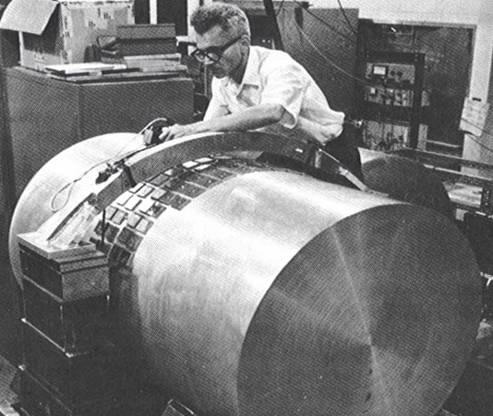
Prof. Weber working on his antenna (c.1965)
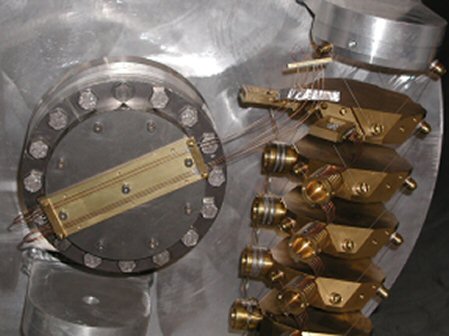
Before the resonant-mass antennas went off the air, the Maryland group collaborated with LSU to improve the sensitivity of ALLEGRO, the 4-K antenna operating at Baton Rouge, Louisiana. To widen the bandwidth to 100 Hz and improve the detection sensitivity to 10-20 Hz-1/2, a two-mode superconducting transducer was constructed at Maryland, which was to be integrated with a two-stage dc SQUID. |
The resonant-mass gravitational wave detector was originally invented in 1959 by late Professor Joseph Weber in our group. The room-temperature detector developed by Weber in the 1960’s laid the foundation for the later cryogenic antennas of improved sensitivity and opened the way to development of laser interferometer gravitational wave detectors. In 1972, Ho Jung Paik, then a graduate student at Stanford University, discovered the resonant transducer concept, which was generalized to a multi-mode transducer by Jean-Paul Richard of our group in 1979.
Maryland transducer on ALLEGRO antenna |